Static fire test
On the 14th of November 2025, a static fire was performed for our engine in a launch pad located in the east of the Netherlands. The aim of the test was to determine and validate the theoretical data for our systems.
Before talking about the test itself, it is important to understand what a static fire is and the importance it has.
A static fire test, as the word suggests, is when an engine is fired but without the rocket being launched. This test recreates the launch burn, making it possible for the team to collect data in conditions as similar as when the rocket is flying. The motor is fixed into a support that holds it while the combustion happens. All electronics and data sensors are close by, collecting and sending the data taken to the team. This trial of the power plant is carried out in order to check and verify the theoretical data obtained from simulations and thus validate if our motor will work as expected.
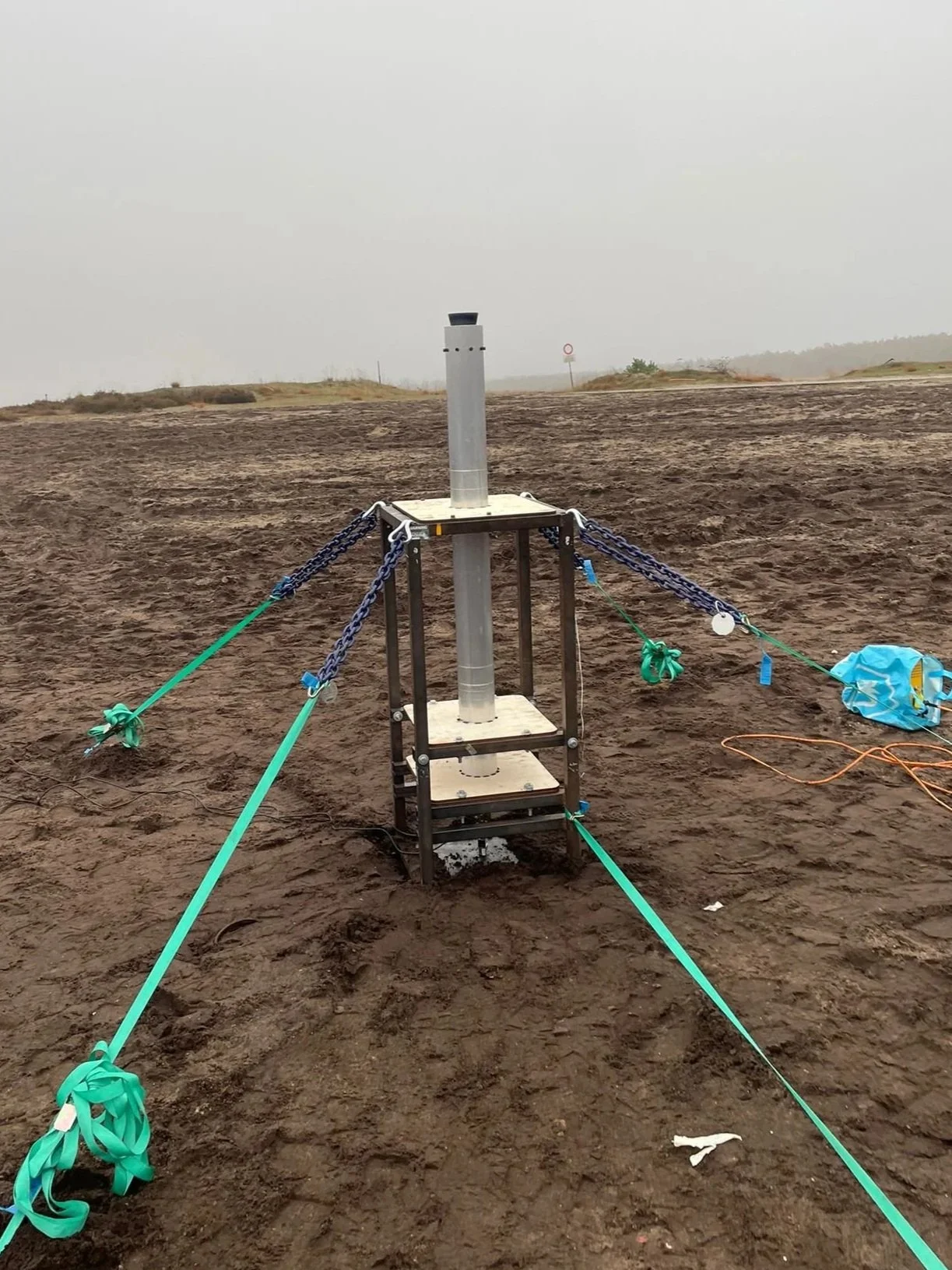
The motor was set in a vertical position, as shown in the image below, to perform the test. It was a collaborative effort within all departments and the safety officers overseeing the general safety during the test. However, two departments played the most crucial roles.
Propulsion, as they are in charge of making the engines and the propellant used in our rockets, was the main department involved. The goal was to obtain data and compare it with the theoretical data to see if the models are correct and if it is possible to optimise thrust.
Electronics, as they are in charge of the electrical systems and obtaining data from them as well as many other things. In this case they provided all systems to ensure the propulsion department knew the performance of the engine.
Static fire results
Although the test did not fully go as planned we could succesfully ignite the motor and take pride in our work. Some parts of our test were succesful, while other aspects will be very useful for the improvement of our motor, which may even be the most important part of such a test.
Video of The test.
We would like to thank our sponsors and collaborators who made this static Fire Test possible
Inholland University of Applied Sciences
Clemessy Microlan
Altium®
AQC BV
NLR - Netherlands Aerospace Centre
Ansys
Dassault Systèmes
Syensqo Würth Elektronik ReqView Sealution Actuonix Motion Devices